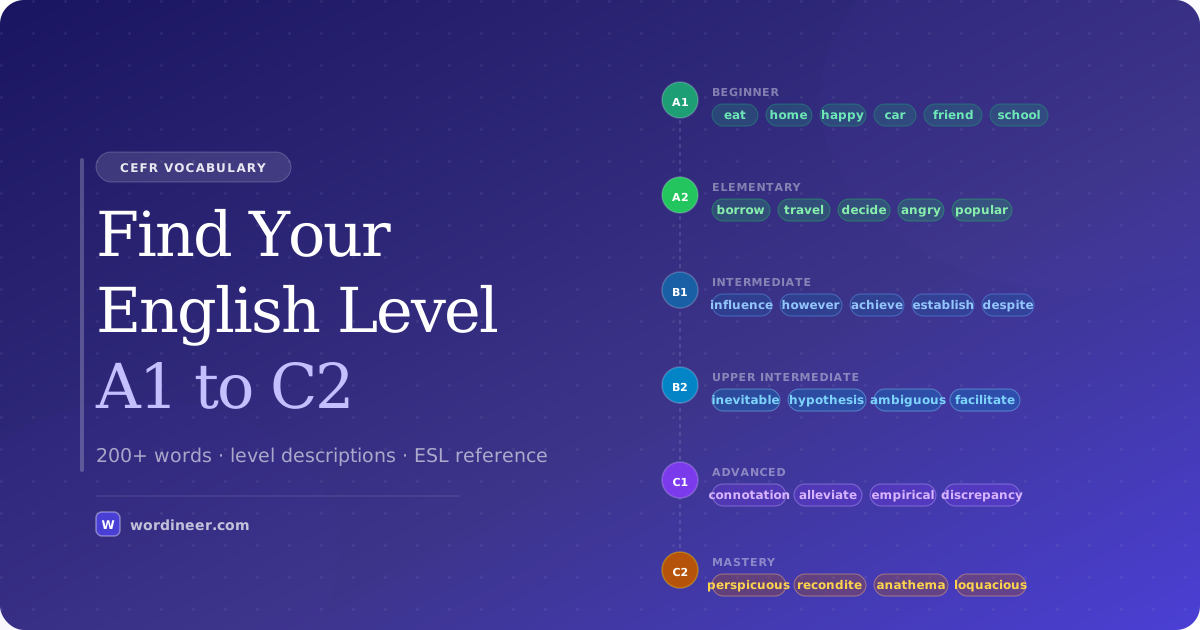
200+ English words organized by CEFR level, with plain-language descriptions of what each level actually means in practice.
The problem with CEFR level descriptions is that they describe ability but don't show you the vocabulary. Official documentation will tell you a B1 learner can "understand the main points of clear standard input on familiar matters" — which is accurate but doesn't help you plan a lesson or figure out which words to study next.
This page shows the vocabulary. Not exhaustive word lists (those run to thousands of entries and aren't useful for browsing), but representative samples — enough to understand what vocabulary knowledge actually looks like at each level, and to gauge roughly where a learner sits.
A1 learners can communicate in basic situations, such as introducing themselves and asking/answering simple questions about personal matters. Other people have to speak slowly and help them a lot. They can use very high-frequency vocabulary that is used in almost every conversation.
At the A2 level, the learner is able to engage in very simple conversations to handle typical everyday situations. Using a vocabulary of common words and basic grammar, they can describe aspects of their environment and engage in brief social exchanges.
B1 learners approach the independent tier. Most children this age can handle most situations, express their opinion, and present information coherently. At this stage of their development, children at the B1 level can understand cause and effect, not just use simple, concrete words to express themselves.
B2 learners are able to communicate in a fluent way and have sufficient vocabulary in order to have regular interactions with native speakers. They are able to explain their point of view on topical issues, give and explain the advantages and disadvantages of a topic, and write long, detailed texts on various topics. Children at this level can use abstract, academic, and professional language.
C1 learners (the second-highest level on the Common European Framework of Reference for Languages scale) have fluent, well-structured speech and writing with little evidence of searching for expressions. Individuals at this level can handle complex subjects, have sufficient vocabulary for social and professional contexts, and understand the implicit meanings of words. This is the level that most graduate programs or professional work environments require, where even non-native speakers can handle complex topics and communicate fluently in various contexts.
C2 is the highest CEFR level — the ability to understand with ease virtually everything heard or read, and to express themselves spontaneously, very fluently, and precisely. It doesn't mean perfect English (native speakers aren't perfect either), but it means having the range and control to communicate any idea, including subtle distinctions of meaning.
Words were chosen based on their inclusion in Cambridge English vocabulary profiles, the Longman Communication 3000, and the 3000/5000 word lists of the Oxford dictionaries. Note that while words have been assigned to a CEFR level, there are variations between the frameworks, and these groupings should be treated as general guidelines rather than absolute criteria. The most complete and well-researched word list for a full production is the Cambridge English Vocabulary Profile available at englishprofile.org.