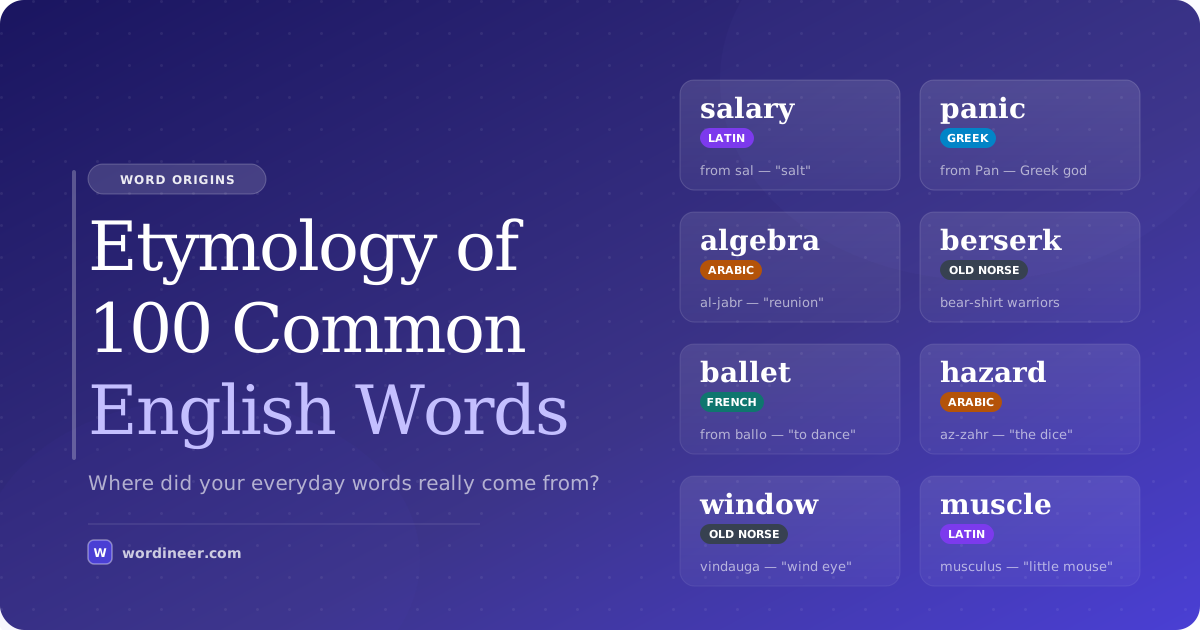
For longer stories organized by theme, semantic drift, eponyms, Arabic and Greek loans, read the etymology essay.
Each path is a simplified tree, click a card to jump to that word in the list.
Root: amir al-bahr (commander of the sea)
The word "Admiral" has a silent "d". The title of Admiral originated from the Arabic word for sea commander, amir al-bahr, or commander of the sea. When the medieval Europeans who first used this title to command on land copied it, one letter was lost. In Latin, this title was called admirabilis, or “worthy of admiration”. Today’s admirals are thus walking around with a 700-year-old copying error.
Modern relatives
emiremirate
Longer story on the etymology essay
Root: al-kohl (the antimony)
Alcohol started as eyeshadow. Arabic al‑kohl was a powdered antimony used as a black cosmetic around the eyes throughout the medieval Islamic world. Alchemists borrowed the word to mean any powder, and later to mean the purified essences and spirits they distilled. By the century, only the strongest of those spirits still carried the name spirits, and the word alcohol described the strongest of those spirits. I find it fascinating how the word alcohol began as a cosmetic and later became a term for liquors.
Modern relatives
kohl
Longer story on the etymology essay
Root: al-jabr (reunion of broken parts)
In the 9th century, the Baghdad mathematician al-Khwarizmi wrote a book called Al‑kitab al‑mukhtasar fi hisab al‑jabr wal‑muqabala. Al‑jabr was his word for moving terms across an equation, meaning "reunion of parts." Medieval European scholars took that word from the title. The idea it referred to became a whole discipline. His own name, when Latinized, gave us the word "algorithm.”
Modern relatives
algorithm
Longer story on the etymology essay
Root: angr (grief, sorrow)
The Old Norse for anger is angr, grief. When this word was borrowed into English in the 13th century it did not have the same hot, hostile sense that it has had for centuries, and is still shown in the word for distress that it evolved into, anguish. For centuries, however, the English word for anger has meant active hostility.
Modern relatives
anguishanxiety
Root: harena (sand)
All of the Roman amphitheaters had sand on the floors. Gladiators and the animals that fought them in the arena left blood on the sand which was frequently washed up. The Latin word for sand is harena, and it was later called the arena, the place where the games were held. Today all of the sports arenas in the world are called by that name.
Root: Hashshashin (nickname; hashish link disputed)
The term assassin comes from medieval Latin assassinus (from Arabic Hashshashin), which was the term used by outsiders to refer to the Nizari Ismailis with whom the Crusaders had become familiar. In accounts of the sect written by medieval European chroniclers such as Marco Polo and William of Tyre, members of the group were referred to as hashish users (from Latin assassinus). However, modern scholarship regards the term “assassin” as a pejorative term coined by the sect’s enemies, and notes that there is no evidence that actual hashish users ever existed. The term was introduced to English by the Crusaders who fought against the Nizari Ismailis.
Longer story on the etymology essay
Root: Atlas (a Titan who held up the sky)
The Titan Atlas holds up the sky on his shoulders in Greek myth, condemned to that punishment forever. Flemish cartographer Gerardus Mercator put an image of Atlas on the cover of his 1595 map collection, and readers started calling any book of maps by the same name.
Longer story on the etymology essay
Root: awariya (damaged goods)
The word “average” originally referred to a loss at sea of goods shipped before there was any concept of mathematics to compute with. When such a loss occurred by shipwreck at sea during a voyage, the merchants who had jointly paid for the goods to be shipped split their losses by the amount of each of their shares; thus, they had an “average” loss — in Arabic, this had been called an awariya, or shipping loss. By the 18th century, mathematicians had found that this way of sharing a loss also described the middle value of any set of numbers.
Root: ege (fear, terror)
“Full of awe” or “inspiring awe and reverence” was the original meaning of the word awful. An awful God is a God who commands such profound reverence and fear. Through much of the 19th century, therefore, awful had two equally current meanings: “awe-inspiring” and “terrible.” By the 20th century, however, only the latter sense had come to be current, and it is this sense that has been inherited by such relatively recent terms as awesome and appalling.
Modern relatives
aweawesome
Longer story on the etymology essay
Root: balletto (little ball, dance)
Louis XIV was a serious dancer, performing in court ballets for twenty years. He codified the dance technique at the Académie Royale de Danse in 1661, and thus, to this day, all positions, jumps, and turns in ballet are called by French names. The art form was developed in the Italian courts of the 15th and 16th centuries under the name of balletto, or “little dance”, but the French vocabulary was sacrosanct.
Modern relatives
ballroomball
Root: Bethlem (Bethlehem)
‘Bedlam’ comes from an old corruption of the name ‘Bethlem’, short for the Hospital of Saint Mary of Bethlehem in London. It was founded in 1247, and within a few centuries it was holding the mentally ill in squalid conditions. By the 16th century, the inmates' screaming was constantly in your ear. Incredibly, visitors would come to the hospital to watch the various inmates as if they were at the circus. And from that, 'Bedlam,' the general term for chaotic, noisy disorder, stuck.
Longer story on the etymology essay
Root: boeuf (ox)
In 1066, the language of the ruling English became French, the language of the Norman conquerors, and this split showed up in something as everyday as the food on the table. The peasants on the land owned by the Norman lords were raising the animals that they had always called by their Germanic names: cow, pig, sheep, and deer. The Norman lords ate this cooked meat, but called it by the corresponding French names: beef from boeuf, pork from porc, mutton from mouton, and venison from venaison. This is how English came to have two words for each of these animals, i.e., because there were two different social classes involved in the transaction. The animals belonged to the peasants; the food belonged to the lords.
Modern relatives
bovine
Root: berserkr (bear-shirt)
The Old Norse berserkr (berserker) were Norse warriors said to fight in a frenzied state, close to madness or trance. They are sometimes depicted wearing bear skins, thus the name bear-shirt (berserkr). Walter Scott adopted the term in his 1822 novel The Pirate, which helped bring it into everyday English use.
Longer story on the etymology essay
Root: blockbuster bomb
A term originally used during World War II to describe very large bombs dropped from planes, so big that one could destroy an entire city block. The Royal Air Force used these so-called “blockbusters” during the war in order to destroy German cities. After the war, the term was used by real estate agents to sell houses in white neighborhoods to Black families, in an attempt to “bust” the racial block. In the 1970s, the term was finally transferred to the entertainment industry and is now used to describe very successful films and books that dominate the market.
Root: ban (bone) + fyr (fire)
The medieval bonfire was in fact a bonefire or a banefire (from Middle English banefire). It was a huge outdoor fire set by medieval towns to burn off bones, whether from plague victims, animals, or executed criminals. On midsummer's eve or the anniversary of a saint's day, the ritual fire doubled as a celebration, a reason for the town to gather and mark the occasion. The large fires of the Scottish midsummer fires (or fire festivals) were of this type. Over the centuries, the smell of the fire had faded from consciousness, the spelling of the word had changed, but the party continued.
Modern relatives
fire
Longer story on the etymology essay
Root: Captain Charles Boycott, 1880
By 1880, the Irish in County Mayo had begun refusing to speak to the Englishman Charles Boycott. He was a collector for a land agent, and they wanted him to cut his rent. By summer's end, newspapers across Europe began using the term for other groups of people who refused to have anything to do with someone.
Longer story on the etymology essay
Root: bangla (of Bengal)
The bungalow originated in Bengal in Northern India. “The Hindi word "bangla" means "of or belonging to Bengal," and this low, wide, often thatched building was the common type of house there. It was perfectly suited for the tropical climate of Bengal. British officers who were stationed in Bengal in the 18th century built bungalows for themselves in other parts of the world and called them bungalows. Over time, the word came to mean any normal single-story house with a large porch.
Longer story on the etymology essay
Root: calculus (small stone)
Small stones did the math. Romans used calculi (or small stones) on counting tables to add, subtract, and multiply. The Latin word for small pebble was thus transferred to the entire area of mathematics, a discipline later developed by Newton and Leibniz. The word for that mathematical discipline is calculus, and is also found in the word for limestone, calcium.
Modern relatives
calculuscalciumchalk
Longer story on the etymology essay
Root: candidatus (clothed in white)
Politicians in ancient Rome donned white togas. Candidates would wear a whitened toga, called a toga candida, to the Forum to project an image of honesty and purity. This is where the name candidate comes from.
Modern relatives
candidcandorincandescent
Longer story on the etymology essay
Root: caput (head)
The word "capital" carries a surprising number of meanings, all of which trace back to the Latin word caput, meaning "head". From caput we get capital (the head city of a region, the head sum of money in a bank account), capital punishment (the punishment that removes a head), and capital as in cattle, which can be accounted for on a per-head basis. All of these meanings come from one body part.
Modern relatives
chiefchaptercaptaincattledecapitate
Root: carne vale (farewell to meat)
The word carnival comes from a festive tradition rooted in language. Carnevale is Italian for "farewell to the flesh" or "farewell to meat," from medieval Latin words for "meat" and "farewell," i.e., "carne vale." Venetians put on the biggest and most notorious Carnival in Christendom, with long periods of frivolous indulgence in masks and costume. At the end of it all, they would stop for the last time on the eve of Lent, and the term for that last night of abandon soon came to be used for the entire celebration of excess.
Modern relatives
carnivorecarnalincarnate
Longer story on the etymology essay
Root: kata- (down) + strephein (to turn)
A catastrophe is the final scene of a play, the climax where things take a downward turn. The word literally means downward turn from kata (down) and strephein (to turn). For centuries, this word carried the connotation of a change of circumstances for better or for worse. Eventually it came to mean disaster.
Modern relatives
apostrophestrophe
Root: Ceres (goddess of grain)
In Roman mythology, Ceres was the goddess of grain, agriculture, and childbirth, equivalent to the Greek goddess Demeter. Thus, Latin cerealis means “of Ceres,” and American English cereal came into use for grains to be eaten for breakfast in the late 19th century from the names of companies that produced these products.
Longer story on the etymology essay
Root: khaos (abyss, void)
Chaos was the first god in Greek cosmology. The Theogony of Hesiod presents a vast and yawning space before the emergence of the gods. This original Chasm was known as Chaos in Greek, derived from the old Greek word 'chein', meaning 'to gape' or 'to yawn'. The void has evolved through the centuries into a symbol of complete and utter confusion.
Modern relatives
chasm
Longer story on the etymology essay
Root: xocolatl (bitter water)
Until the Spanish conquistadors came to the New World in the 16th century, chocolate was a cold, bitter, frothy drink. The Aztecs had been making xocolatl (from xococ, 'bitter'; atl, 'water') long before the Europeans arrived. They mixed it with chili peppers and ground corn, and it was considered a ritualistic drink. The Spanish added sugar to the drink, and within a century it had spread from the royal courts of Spain to coffeehouses across Europe.
Longer story on the etymology essay
Root: circus (circle, ring)
Circus is a direct borrowing from Latin circus, ‘ring’, ‘circle’. The ancient Roman Circus Maximus was an oval-shaped public stadium with seating for crowds to watch chariot races and other public spectacles. In the 18th century, the name of this venue was borrowed by traveling shows with acrobats, aerial performers, and animals.
Modern relatives
circlecircuitcircacircular
Root: clicher (to stereotype)
Cliché: The printing press was invented by the French. One of the sounds of typesetting was a click, which gave French printers the verb clicher, meaning to cast a stereotype plate. Because stereotype plates reproduced the same text over and over, cliché came to mean any overused phrase, something writers have since taken to heart.
Root: clew (ball of yarn)
This word was derived from the name of Ariadne, daughter of King Minos of Crete, who gave the Greek hero Theseus a ball of yarn (Old English cleowen) before he entered the famous Labyrinth, which he used to find his way back out after he had killed the Minotaur. By the 16th century the term had evolved to mean any piece of evidence that might lead someone to an answer.
Longer story on the etymology essay
Root: qahwa (wine of the bean)
Coffee was born in the highlands of Ethiopia and made its way to Yemen, where it became a favorite drink of Sufi monks. Arabic qahwa originally meant wine, but when Arabs discovered the black, bitter, and stimulating drink made from roasted coffee beans, they named it qahwa, and later it was brought to Europe by the Ottoman people of Istanbul in the 17th century and became a 100-year novelty which changed the Western way of life considerably.
Modern relatives
cafécaffeine
Longer story on the etymology essay
Root: com- (with) + panis (bread)
A “companion” or “fellow” literally means “someone with whom you eat bread.” This is the Late Latin companio formed from com- (with) and panis (bread). The soldier who shared a ration from the same unit’s pack with his comrades was called his companion.
Modern relatives
companyaccompanypantry
Longer story on the etymology essay
Root: qutn (cotton)
Cotton's name traces back to Arabic qutn, originating in the region around Madras (now Chennai) in India, from where Arab merchants carried both the crop and its name westward. From there it spread to the rest of the Arab world and in the 12th century was introduced to the medieval West by Arab merchants. The Arabic name for it, qutn, was the one used in trade. It has traveled to all corners of the globe and become part of language after language: cotton, coton, cotone, algodón.
Longer story on the etymology essay
Root: couvre-feu (cover the fire)
The word “curfew” comes from an old French word cuevre-feu meaning cover the fire. It refers to the evening bell, first introduced in medieval England by William the Conqueror in 1068, which instructed townspeople to cover their hearths for the night to prevent fires in a wood-built world. The bell was later abolished, but the word remained.
Longer story on the etymology essay
Root: demos (people) + kratos (power)
The word democracy for a political system was coined in fifth century Athens, when demokratia (the people having power) was first tried out. The founding fathers of democracy excluded women and slaves from the demos of full citizens, and many foreign residents. For 2,500 years since then, from republics to representative governments, democracy has been the object of human attempts to get it right.
Modern relatives
pandemicepidemicaristocracybureaucracy
Root: dis- (bad) + astro (star)
Disaster: From 'Bad Star'. The Italian word disastro is built from dis- ('bad') and astro ('star'), reflecting the medieval belief that disasters were caused by a bad star appearing in the heavens.
Modern relatives
astrologyastronomyasterisk
Longer story on the etymology essay
Root: des- (not) + aise (ease)
Disease used to mean discomfort. Old French desaise, literally “not at ease,” had referred to an uncomfortable feeling or awkwardness. It wasn’t until the late medieval period that medical writers began to restrict the term to a number of physical malaises. A century or so later, the older sense had generally fallen out of use, although the idea of being generally “ill at ease” is captured in English by the word unease.
Modern relatives
easeuneasy
Root: John Duns Scotus (1266–1308)
Dunce. Named after John Duns Scotus, a brilliant medieval philosopher. His followers, the Dunsmen, dominated European universities in the 13th and 14th centuries. The Renaissance humanists, however, considered the Dunsmen hopelessly old-fashioned and therefore regarded them with scorn. One of the greatest minds of the Middle Ages was eventually scorned with a term denoting stupidity.
Longer story on the etymology essay
Root: egg (egg)
In Old English, the word for egg was ey, but the Norse word egg was in use in northern England. For centuries in England this was a puzzler: in William Caxton’s words (c.1490), a merchant of Kent was unable to buy eggs laid daily in the market because the local word for them was ey.
Root: genu (knee)
Genuine may come from the Latin word genu, meaning knee. The word traces back to an ancient Roman custom in which a father would place a newborn child on his knee to acknowledge the child as his own. The child placed on his knee was thus his genuine own, of his blood and genus.
Modern relatives
genusgenerategender
Root: grammar (occult knowledge)
Glamour is a Scottish form of the word grammar. Medieval scholars of great learning, mostly of the clergy, learned to read in great schools and they seemed to possess magic, or to be given the benefit of it. In medieval Scottish dialects, this grammar was known as ‘grammar’ or ‘glamour’. The modern word glamour refers to the magic of the world of ‘real’ life.
Modern relatives
grammargrimoire
Longer story on the etymology essay
Root: grotta (cave, grotto)
In the late 15th century, diggers unearthed a portion of the buried rooms of the Roman emperor Nero’s Domus Aurea, or Golden House, in Rome. The underground spaces were referred to as grottos, or “caves,” because they had been buried for centuries. In these painted underground rooms, partially buried beneath other buildings, elaborate vines sprawled across walls. Human forms merged with plants, while animals sprouted from vines. Small fantastical creatures filled the spaces between. Renaissance artists copied the style and called it grottesca, or "cave-style," the word that became our modern "grotesque." From this, we now refer to any distorted or bizarre form as grotesque.
Modern relatives
grottocrypt
Root: gymnos (naked)
In ancient Greece, athletes trained naked for their sport. Gymnasion comes from the Greek gymnos, meaning naked, and simply means a place for exercising. The practical aspect of training naked was that nothing could get caught in or torn by athletic exercises. The symbolic aspect was that everyone was equal, no matter how rich, for they all exercised naked. From that same root, the Germans today call academic high schools Gymnasien, and the English speak of the gymnasium, where students dress in clothes far more elaborate than those of the Greeks.
Modern relatives
gymnasticsgymnast
Longer story on the etymology essay
Root: az-zahr (the dice)
Hazard is a dice game that the Crusaders learned from Arab merchants in the Levant. ‘Az-zahr’ is Arabic for ‘the die’ and was brought back to Europe by the Crusaders, where the name of the game was so filled with peril that it was also used to describe any uncertain or risky situation. Today, Hazard is played in casinos as modern casino craps, and the term is still visible in the game's rules.
Modern relatives
hazardous
Longer story on the etymology essay
Root: huracán (god of the storm)
Huracán was the storm god of the Taino people of the Caribbean. When Spanish explorers first met an Atlantic tropical cyclone in the late 15th century, they took the god's name for the storm and carried it back to Europe. The Taino themselves were nearly wiped out by colonization, but their words for the region's realities (hurricane, hammock, canoe, barbecue) stayed in English.
Root: augur (diviner of omens)
Roman augurs studied birds before beginning a new office, a battle, or the construction of a temple. All inaugurations in all ages are, technically speaking, still taking the auguries first; that is to say, they are asking the birds for permission to start.
Modern relatives
auguraugmentaugust
Root: jangal (wasteland, forest)
The word ‘jungle’ originally meant a wasteland or uncultivated country, such as scrubby dry ground. In Hindi, the word for this is jangal, derived from the Sanskrit word jangala. British officers in India describing struggles against dense tropical vegetation sent the word home with the reverse connotation, so that today in English imagination the word represents a dense, dangerous, very green piece of country. It is a British colonial creation.
Longer story on the etymology essay
Root: kê-tsiap (brine of pickled fish)
English ketchup originally contained no tomatoes. The name of this condiment comes from the Hokkien Chinese expression kê-tsiap or the Malay expression kicap. These terms refer to a salty fish or shellfish sauce that was brought to Asia by British sailors in the 17th century. In England, the sauce was made by cooks using mushrooms, walnuts, and anchovies. It was not until the early 19th century in America that tomatoes were added to the recipe.
Longer story on the etymology essay
Root: makhazin (storehouses)
For a long time, a magazine was a storehouse. Arabic has makhazin (plural of makhzan), meaning "treasury" or "warehouse". The word came into English from French and Italian, and at first it denoted an arsenal, a storehouse of gunpowder, weapons, or ammunition: gunpowder magazines, weapon magazines, ammunition magazines. Printers of the 18th century sometimes described their periodicals as magazines for ‘miscellaneous articles’ or simply as a storehouse of writings. Today, guns still use the term "magazine" to refer to their ammunition magazines.
Longer story on the etymology essay
Root: manus (hand) + facere (to make)
Originally, the word "manufacture" referred to "handmade," or anything made by hand. It comes from the Latin words 'manus' (hand) and 'factura' (a making). This was coined in the English dictionary in the 16th century to describe items made by artisans or craftsmen. It was only much later (mid-1700s), when the Industrial Revolution moved production into factories run by machines rather than hands, that "manufactured" came to mean the opposite of "handmade." Today, the word 'manufacture' refers to factories producing products using machines rather than by hand.
Modern relatives
manualfactoryartifactfacility
Root: Marathonos (place name)
In 490 BC, on a plain northeast of Athens, a much smaller Greek army defeated the Persian invasion force at the Battle of Marathon. According to legend, the Greek soldier Pheidippides ran from Marathon to Athens to announce the Greek victory to the citizens of Athens and then collapsed and died of exhaustion. This legendary run was commemorated at the revival of the modern Olympic Games in 1896 with a race of approximately 26 miles and 385 yards (42.195 kilometers) on the plain at Marathon, and it has since become the Marathon.
Longer story on the etymology essay
Root: matrah (place where something is thrown)
Crusaders returning from the Holy Land brought back a piece of Arab bedding, cushions or padded mats laid on the floor, that was substantially more comfortable than European straw. The Arabic name for the object was matrah (from taraha, "to throw down"), literally "a place where something is thrown or laid down." Europeans kept the word for the pad. The floor part was quietly upgraded to a frame.
Longer story on the etymology essay
Root: Maiandros (a river in Turkey)
The Maiandros River in western Turkey flows in a series of winding curves, and the name has become synonymous with any winding path or route. The unique bends of the Maiandros were studied by the ancient Greek geometers, and the elaborate curves were used by Roman decorators designing key-pattern borders. That same river and its name survive today, still used across many languages to describe a winding path.
Longer story on the etymology essay
Root: Mentor (character in the Odyssey)
The term ‘mentor’ comes from Odysseus, the star of Homer’s epic, the Odyssey. The hero, off fighting in the Trojan War, had entrusted his household to his friend Mentor, and later Athena, the goddess, would often appear as Mentor to the old man's young son. François Fénelon wrote a novel called The Adventures of Telemachus in 1699, and by the 18th century ‘mentor’ became the English word for a guide, guardian, or instructor.
Longer story on the etymology essay
Root: Moneta (title of Juno)
The Roman mint was situated in the temple of Juno Moneta on the Capitoline Hill. The coins which the mint struck bore the title of that goddess, and thus, from the temple of Juno Moneta, her title was translated into Old French moneie, English money.
Modern relatives
mintmonetarymonitor
Longer story on the etymology essay
Root: mort (dead) + gage (pledge)
As Pottie points out, mortgage is an old pledge that dies, either when the debtor pays the loan off, or when the property is forfeited to the creditor in case of default. It is thus a dead pledge, or a “dead” loan as Pottie says; in other words, a small tomb for every homeowner.
Modern relatives
mortuarymortalamortize
Longer story on the etymology essay
Root: musculus (little mouse)
The muscle was given the form of a small mouse by the Romans. Hence the Latin term for muscle, musculus (little mouse). Mussel is derived from the same word, via the notion of a mouse curled up in the shell of a mussel.
Modern relatives
mussel
Longer story on the etymology essay
Root: Mousa (the Muses)
From Greek mousike, 'art of the Muses.' The nine Muses were Greek goddesses who presided over arts and sciences. Mousike originally covered poetry, dance, and song together, all arts inspired by the Muses. The modern narrowing to organized sound came through Latin and Old French.
Modern relatives
museummusemosaic
Root: naïf (natural, unaffected)
For a long time naïve meant natural, unspoiled, unaffected. In the 17th century, writers even praised the unforced simplicity of the native, the child, in descriptions of peasants. It took two centuries for the meaning to change to inexperienced, and then gullible. The two dots in the i tell you that, in French, naïf and naïve are pronounced with two vowels separately.
Modern relatives
nativenativity
Root: Narkissos (mythological youth)
The myth of Narcissus, a handsome youth who fell in love with his own reflection in a pool and faded away, has been around for a long time. A narcissus flower grew from where he died. Sigmund Freud borrowed this ancient myth in 1914 when he coined the term for a particularly self-absorbed personality type: the narcissus is even younger than the word.
Modern relatives
narcissusnarcotic
Longer story on the etymology essay
Root: nescius (ignorant)
English words like 'nice' have changed much in meaning over the centuries. One of the biggest changes has been in the word "nice", which went from a negative meaning to a positive one. It originated from the Latin nescius, meaning 'ignorant' or 'unaware', and in Old French the word nice was used to describe someone who was 'foolish' or 'silly', basically an insult. By the 14th century, the connotation had shifted somewhat to describe someone ‘wanton’ or ‘lascivious’, while by the 15th century the word described someone ‘coy’ or ‘shy’. A century later, the word nice evolved to describe someone 'refined' and 'precise' in nature. By the 18th century, it had settled on the most commonly used definition today of 'agreeable' and 'pleasant'. The word has undergone a very impressive change from ‘stupid’ to ‘good’ over a 5 century period.
Longer story on the etymology essay
Root: niht (night) + mare (evil spirit)
A mare was once a female demon, not a female horse. In Germanic and Norse folklore, a mære would lie on the chests of sleepers, causing them to choke to death from extreme fear; a niht-mære was a night goblin. There is a striking spelling coincidence between this and the word for female horses. It was once called “incubus” in the Middle Ages for centuries before it got a modern medical name.
Longer story on the etymology essay
Root: Palatium (Palatine Hill, Rome)
It was here that the first of Rome’s seven hills, the Palatine, was to become the home of Augustus and subsequent emperors, and thus give its name to the term for grand residence in Europe – a Palace.
Modern relatives
palatial
Root: Pan (god of wild places)
The god Pan lived in forests and mountains, and if you woke him from his midday nap he made you afraid. Greeks called that sudden, causeless terror panikon, "of Pan." Every mass fright of unclear origin was Pan's doing. "Panic attack" still carries the god's fingerprint.
Modern relatives
pandemonium
Longer story on the etymology essay
Root: pairidaeza (walled garden)
From the Garden Wall to Paradise. The medieval concept of Paradise was a walled garden, in which exotic animals and plants were kept by Persian kings in walled parks called pairidaeza (from pairi, around, plus daeza, wall), later Paradise in Greek paradeisos.
Longer story on the etymology essay
Root: philos (loving) + sophia (wisdom)
He called himself a “lover of wisdom” (philosophos in Greek) and refused to be referred to as a wise man, as this person would possess wisdom, whereas the love of wisdom is something that you search for.
Modern relatives
philosophysophisticatedsophomore
Root: phos (light) + graphe (drawing)
Photograph: from Greek phos/photos (light) + graphein (to write or draw). The term for a photograph was coined by British scientist John Herschel in 1839 and is literally ‘writing with light’. The inventor of photography, Herschel, also introduced other photographic terms to the scientific community, such as positive, negative and snapshot. The Greek-root compound system allows scientists to make full and descriptive reference to their latest inventions.
Modern relatives
photographyphotonphotosynthesisgraphicbiography
Root: porc (pig)
Pork. The term comes from Old French porc (pig). As with beef, the basic term for pig or swine was retained by English-speaking peasants of Germanic stock, while nobles of French stock referred to the meat they ate. “Pork barrel” is an Americanism from the politics of that country.
Modern relatives
porpoiseporcupine
Root: propagare (to propagate, spread)
The word Propaganda comes from the Catholic missionary committee that was established by Pope Gregory XV in 1622, called the Congregatio de Propaganda Fide, or the committee for the propagation of the faith in contested territories. It was a term for organized persuasion, and it acquired a rather darker complexion in the 20th century after two wars of massive state propaganda.
Modern relatives
propagatepropagation
Root: quarantina (40 days)
The Venetians invented quarantine. To keep the Black Death from entering their city, they had ships anchoring offshore for forty days (quaranta giorni in Italian). The forty days came from the length of time of the flood and the forty years of the Israelites’ wandering in the desert. We know it today under the shorter name.
Modern relatives
quadrantquarter
Longer story on the etymology essay
Root: possibly Qui-es or Who are you?
The origin of the word quiz is unknown. A Dublin legend has it that in 1791 a theater owner made a pact to coin a word by breakfast, scrawled ‘quiz’ all over the town, and by morning won his wager. This etymology, however, is unsubstantiated. The most popular solution is that quiz comes from the Latin quis (who), or that it is a truncated form of inquisition. One of the few real mysteries of the etymology of English.
Root: restaurer (to restore)
Parisian restaurants, which opened in the mid 1760s, first served restorative broths. Upper-class people would go to these restaurants to eat an invigorating soup instead of a full meal. The French verb restaurer (to restore) is the root of the word restaurant, and by the end of the 19th century it denoted a place where individual dishes were served. The healing quality of the original bouillon had by then been lost.
Modern relatives
restorerestoration
Root: rivalis (sharing a stream)
Since farmhands on the same stream could be at odds with each other for the water, the Latin for “one who uses the same stream” is rivalis, “stream-user,” from rivus, “stream.” The particular type of quarrel over use of the same water became the general term for competing with anyone over anything.
Modern relatives
riverderivearrive
Longer story on the etymology essay
Root: robota (forced labor, drudgery)
The Czech word for forced labor is robota. The term Robot was apparently coined by Czech writer Karel Čapek in his 1920 play R.U.R. (Rossum's Universal Robots) together with his brother Josef who suggested the title over coffee in a café in Prague.
Longer story on the etymology essay
Root: sabot (wooden shoe)
Sabots are wooden shoes. French factory workers wore them, and during labor disputes in the early 20th century they were said to jam the shoes into machinery to shut down production. Whether that ever actually happened is disputed, but "to work like you are wearing sabots" (clumsily, slowly, with intent) gave French saboter and English sabotage.
Root: sal (salt)
Salary is a Latin word for salt money: Roman soldiers were paid a salarium so they could buy salt, and the phrase "worth his salt" is 2,000 years old.
Modern relatives
saladsaucesalsabrine
Longer story on the etymology essay
Root: John Montagu, 4th Earl of Sandwich
John Montagu, 4th Earl of Sandwich, was a heavy gambler. Around 1762 he reportedly asked his servants to bring him meat between two slices of bread so he would not have to leave the card table. Whether the story is true or invented by his critics, his title stuck to the food and travelled into every European language.
Longer story on the etymology essay
Root: skhole (leisure, discussion)
School was a form of leisure time. The Greek word for school, skhole, referred to time away from work to pursue one’s interests and have free time to discuss topics of interest with fellow citizens. People with others to work for them were the first to have such time, so education became a luxury of the free-born. We still use the word to connote that sense of leisure.
Modern relatives
scholarscholastic
Longer story on the etymology essay
Root: Serendip (old name for Sri Lanka)
Serendipity was invented by Horace Walpole in a letter of 28 January 1754. The name Serendip comes from an old Persian name for Sri Lanka, used in a fairy tale about three princes who very quickly and very cleverly solved problems that cropped up through sheer good luck. The English word describes happy discoveries by chance that the discoverer did not have in his or her sight. It is one of the very few English words with a documented birthday and an inventor. This one has both.
Root: chāmpo (press, knead)
Shampoo was a head massage before it was a bottle. Hindi chāmpo ("press, knead") was the imperative of chāmpnā, and Indian bathhouses offered the scalp pressing as a service. British colonists in the 18th century brought the word home for the massage itself. The hair-washing sense only attached in the 19th century, when soaps for it started being sold under the name.
Longer story on the etymology essay
Root: Étienne de Silhouette (French minister)
Étienne de Silhouette (1709–1767) was the infamous cheap French Controller-General of Finances. In 1759, he cut spending to the bone as Finance Minister, earning Silhouette a most unfortunate association with all things cheap. It was black cutout silhouettes of profile portraits, installed in hallways or other areas as very cheap substitutes for real paintings, that earned the term.
Longer story on the etymology essay
Root: sælig (blessed, happy)
In Old English, sælig was a highly positive term that translated as blessed, happy, fortunate. By the time Middle English had rolled around in the 1300s or so, the term had taken on a rather more complex set of meanings, including pious or innocent. In 15th century usage, however, this innocent state was recognized as naive or even simple. And by the 16th century, or so, it had come to mean the opposite of all these: foolish. That is to say, the word, which had once denoted someone who was blessed by the divine, had, in the space of 500 or so years, gone into reverse.
Longer story on the etymology essay
Root: sincerus (pure); 'sine cera' story is folk etymology
Sincerus: From Latin sincerus, pure or unmixed. The story that work done honestly is work “without wax” is a piece of folk etymology passed down for centuries. Although it makes a nice story that dishonest sculptors hid flaws in their marble with wax, it is not found in any Roman writings. The etymologists of today are of the opinion that sincerus comes from the Proto-Indo-European roots sem- (one) and ker- (grow). The wax story is famous because it is so memorable, not because it was ever documented.
Modern relatives
wax
Root: ský (cloud)
Sky used to mean cloud. Old English had a serviceable word for the heavens (heofon, "heaven"), but Norse settlers in the 9th century brought ský ("cloud") with them, and the word migrated upward: from the clouds to the whole vault above the clouds. Heofon retreated into religion. Sky took over the weather.
Root: sluagh-ghairm (army shout)
Slogans started as war cries. Scottish Highland clans shouted a family sluagh-ghairm ("army shout" in Gaelic) as they charged into battle, and English writers who encountered these cries during the Jacobite conflicts of the 17th and 18th centuries anglicized the word. By the 19th century a slogan was a striking phrase for advertising or politics, still meant to be shouted, still meant to move a crowd.
Longer story on the etymology essay
Root: Tantalos (mythological king)
Named after Tantalus, a king in Greek mythology who offended the gods and was punished in Hades by being made to stand in a pool of water beneath fruit trees. When he reached for the fruit, branches pulled away; when he bent to drink, the water receded. His name gave English the verb 'tantalize', to tease with something desirable just out of reach.
Longer story on the etymology essay
Root: ta'rifa (notification, schedule of fees)
From Arabic ta‘rifa, ‘notification’ or ‘inventory of fees’ (from arrafa, ‘to notify’). The word entered European languages through contact with Arab merchants in the Mediterranean. In this sense, a tariff was an inventory of charges, or a list of duties, posted in markets or at the harbors of towns, and thus constituted an official notification of the rates of charges to be paid on particular articles.
Root: tele (far) + phone (voice)
Coined in the 19th century from Greek tele (far off) + phone (voice, sound). The elements were classical Greek but the compound word was new, invented to name a new technology for transmitting voice over distances. Alexander Graham Bell registered the patent in 1876. Many scientific coinages of the 19th–20th centuries follow this pattern of Greek-root compounds.
Modern relatives
televisiontelegramphoneticsmicrophone
Root: theatron (a place for viewing)
The term theatre originates from the audience. In ancient Greek, the term theatron (theatre) refers to a place where people view something, i.e., theasthai (to behold). So, in essence, a theatre is a structure of tiers of seats built into the side of a hill or even in a circle, allowing for good sightlines to the action on the stage, and that is what theatre is all about – viewing something.
Modern relatives
theorytheorize
Root: tragos (goat) + ode (song)
Tragedy is literally “goat song.” Greek word tragoidia is composed of tragos (goat) and ode (song). Tragedy remains the most important term in Western drama, and yet the reason for its name remains an unresolved goat business. If anything, the tragedians of ancient Greece were performing as goat-skinned persons in Dionysia competitions, perhaps even being awarded a goat or two for their performances, or perhaps they played satyrs singing and dancing in chorus.
Modern relatives
tragicodeummelody
Longer story on the etymology essay
Root: travail (hard work, torture)
The word travel comes from a torture device. The Old French word travail (penal labour etc.) comes from the Vulgar Latin tripaliare (to torture with a tripalium, a three-staked frame). Medieval journeys were often arduous (bandits, weather, disease, etc.) and could take months on foot or horseback. So the same word was used for both the journey and the ordeal. Later, English differentiated between the two by using travail for the ordeal, and travel for the trip. But once, travel was a form of travail.
Modern relatives
travail
Longer story on the etymology essay
Root: theriake (antidote against wild beast bites)
From ancient Greek theriake antidotos (an antidote for animal venom) to the complex mixtures of ingredients sold by medieval apothecaries under the same name (guaranteed to cure you of any poison), treacle has always been a mysterious substance. In the 18th century, it was simply molasses.
Longer story on the etymology essay
Root: trivium (three roads)
The Latin word trivium described the place where three roads met – and that is where the locals would gather to gossip about trifling matters as they stopped on their journey through the crossroads. Interestingly, the term trivium was also used to refer to the three subjects studied in the earliest medieval universities: grammar, logic, and rhetoric. The name stuck for a while, but was later dropped in favor of another term.
Modern relatives
triviaviaviaduct
Root: taikun (great lord)
The term taikun (great lord) was introduced by American diplomats who traveled to Japan in the 1850s. They applied it to the shogun. When American President Lincoln was in the middle of the Civil War, his cabinet jokingly referred to him as "Tycoon," or "great lord." This was an American joke about the increasing power of the President. It was a term that, by the end of the century, was transferred from politicians to industrialists and has remained with them since.
Longer story on the etymology essay
Root: typhon (whirlwind)
Typhoon entered the English language through two routes that eventually converged on the same spelling. Typhoon came from the Greek word for a monstrous storm god, Typhon, who battled Zeus with serpent legs. It also came from the Chinese word for a big wind, tai fung, which the Portuguese called tufão when they arrived in the Portuguese colonies of Asia. In the 16th century, the two meanings of the huge tropical cyclones of the Pacific and Indian Oceans were merged into a single English word.
Modern relatives
typhus
Root: uggligr (fearful, dreadful)
In Old Norse, ugly meant terrifying. The word uggligr is derived from ugga, ‘to fear’. Something ugly was something threatening, dangerous, or menacing. The change in English from ‘frightening’ to ‘ugly’ or ‘unattractive’ took place in Middle English, a slow process of softening a very powerful word. Something that was once perceived as a danger to others or even a threat became merely something that was distasteful to the eye.
Root: vilain (farmworker)
The origin of the word ‘villain’ was a farmhand. Old French vilain described the peasant who worked on a villa or landed estate of a noble. The medieval nobility used this word to describe country people who were rough, dirty, and uneducated. In modern English, we still use the word ‘villain’ to describe a wicked person, with all the class prejudice of the ruling class that originally used the word.
Modern relatives
villagevillavile
Longer story on the etymology essay
Root: Vulcanus (Roman god of fire)
According to Roman mythology, Vulcan, the god of fire and metalwork, had his forge on the island of Vulcano, north of Sicily. Therefore, every volcanic eruption was considered to be sparks from his hammer. The Italian sailors, who discovered other fire volcanoes, brought the name of the god with them. In the 17th century, the term “volcano” became the generic name for these fire-spewing mountains.
Modern relatives
vulcanize
Root: uisce beatha (water of life)
Whisky is Gaelic for “aqua vitae”, or “water of life”, which medieval Latin-speaking monks produced and called by that name. The phrase was translated into Gaelic as “uisce beatha”, which the English have since reduced to “whisky”. The French do the same for brandy, calling it “eau-de-vie”, which means “water of life” as well.
Root: vindauga (wind-eye)
Window is Old Norse for wind-eye. The Viking settlers of Britain brought the word vindauga to our language. The first part of the word, vindr, means wind, and the second part, auga, means eye. So the word window must refer to the small hole in a wall which brought air and light into a room before cheap glass was available. This word replaced the Old English word for window, eagþyrl, which is best translated as eye-hole. The wind still looks through every window.
Longer story on the etymology essay
Root: yuj (to yoke, unite)
Yoga means yoke. Sanskrit yuj (to yoke, harness) is the root, and the discipline of yoga is meant to yoke the individual self to universal consciousness. English "yoke" (the wooden bar over two oxen) and Sanskrit yuj share a Proto-Indo-European ancestor. Yoga class, in the strictest etymological sense, is training in harnessing yourself.
Modern relatives
yoke
Root: sifr (empty, nothing)
Zero as an idea preceded its name: Sanskrit shunya (void) or sifr (empty), as translated by Arab mathematicians who transmitted the concept to medieval Europe, where it became the foundation of positional arithmetic. Although the sifr came to medieval Europe as early as the 12th c., for many years merchants preferred Roman numerals for their accounting books into the 16th c., fearing that a number for nothing would lead to unfavorable columns.
Modern relatives
cipher
Longer story on the etymology essay