Written by Garrick Dee · Published July 2026 · Last verified August 2026
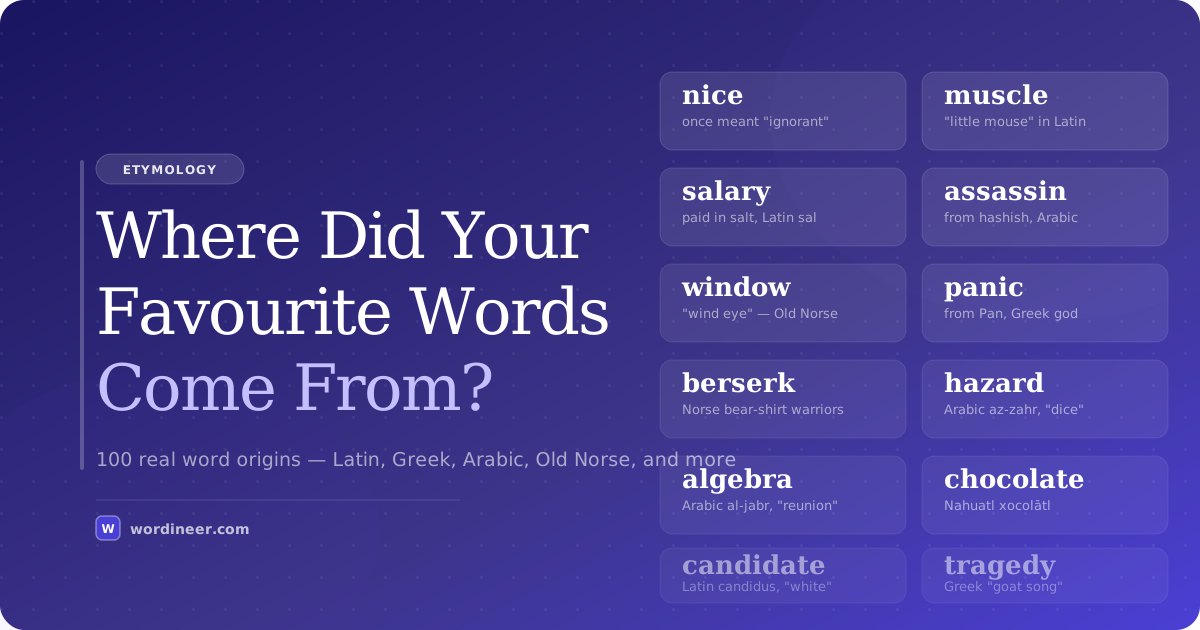
The word 'nice' has been in the English language for centuries. It was first brought over from France in the 13th century. Originally, it meant ignorant, foolish, or timid. By the 18th century, it started to take on a more positive meaning, eventually becoming pleasant. The word "villain" comes from Old French and literally means "farm worker". The word Berserk comes from Norse warriors who would don bear skins and enter a frenzy before battle.
The language you speak today is an historical accident. Latin was layered over Anglo-Saxon, and then French was imposed on the resulting Pidgin after 1066. Much Arabic was introduced to England by trade, whilst the Aztecs contributed Nahuatl to the island. A few Japanese words slipped in too. Today you can trace any ordinary word to something more interesting.
Here are 100 real etymologies sorted by theme, mostly randomly, and all have been checked against normal reference works. Many will surprise you. A few could even be considered bothersome.
To filter these origins by language, search the list, or download the data, use the 100-word origin reference.
Words that stopped meaning what they used to
The semantic drift is relentless. These words have deviated so far from their origins that their original meanings now often evoke repulsion or confusion.
- niceLatin nescius → Old French nice
The word nice originally meant 'foolish' or 'ignorant' (13th century), then 'timid' (14th century), then 'fussy' (15th to 17th century), and finally 'agreeable'. It took about 500 years to travel from that to the above word. (Through Old French nice (foolish) and into Middle English as simple or even wanton. By the 18th C it had become the least threatening word in the language).
- sillyOld English sælig
Sælig meant blessed. Spiritually fortunate. The word shifted through "happy" and "innocent" to "simple" to "deserving of pity" before landing on its current meaning. Each step of that journey made sense to the people doing the shifting — it's just that pity and simplicity and blessed are not the same thing.
- awfulOld English egeful
Awe, in Old English, was close to terror — the feeling you had standing before something vast and incomprehensible. Awful meant inspiring that feeling. "The awful power of the sea" was a compliment. Somewhere in the 19th century the word lost its grandeur and started meaning merely bad.
- weirdOld English wyrd
The Old English word for fate was wyrd, an inevitable and unchangeable course of events. In Macbeth, the Weird Sisters are simply the Fates. The meaning of the word has weakened over the centuries and now generally means strange.
- villainMedieval Latin villanus
The word originally came from the Latin word for a person who lives and works on a villa, or farm. That the aristocracy did not have much respect for the people who worked on the farms would make sense to most people. When the word was borrowed into English, the moral coding of rural = uneducated = untrustworthy = evil was already in place. The French word for this class, vilain, was also used as an insult, e.g., "you vilain!" Thus, the English language came to associate this class of people with all that was bad about them through two different routes.
- naughtyMiddle English naught
From naught — nothing. To be naughty was to have nothing, to be impoverished. The moral judgment came later, the same way it did with villain. Poverty and bad character were conflated so routinely in medieval English that the language just absorbed it.
- hussyOld English hūswīf
A huswif was simply a housewife — the female head of a household. Hussy, like the word villain, has contracted from a fully respectful term to its current pejorative via normal spoken language and the same social reductions that have affected the preceding word. It is a fully respectable term by definition.
- braveSpanish/Italian bravo
Bravo originally meant wild or savage — specifically the uncontrolled wildness of someone who didn't follow civilized norms. Calling someone brave was initially closer to calling them feral. The meaning softened into bold, then courageous. The Italian bravo (as in bravo, well done) is the same word taking a slightly different path.
- stupidLatin stupidus
Stupere: to be stunned or dazed, as in stupor. Stupidus: too stunned or astonished to function. That sense of permanent incapacity changed over time. Today, when we call someone "stupid," we are literally saying that he looks as though he has just been hit by something.
- paganLatin paganus
Paganus simply meant a person from the countryside — a rural person, as opposed to someone from the city. Christianity spread through Roman cities first. By the time it reached rural areas, "city person" had become synonymous with "Christian," and paganus had picked up its religious meaning by default. Country people were the last to convert, not because of what they believed but because of where they lived.
- prettyOld English prættig
That word for "pretty" originally meant cunning, crafty, full of prætt or tricks. So in a sense, you're calling that person sly. It drifted to "clever," "ingenious," "excellent," or "fine," and finally settled on physical attractiveness, while retaining the word's sound. It's a compliment instead of a moral judgment.
- egregiousLatin egregius — ex- (out of) + grege (ablative of grex, flock)
Egregius meant standing out from the flock — distinguished, eminent, excellent. It was a compliment. When the English borrowed the term from Latin, irony took over in due course. We call a mistake egregious now. Most people realize that egregious was first used to describe something remarkable — good, that is — and only later did it come to mean remarkably bad. The structure remains the same; it's the tone that's changed.
- sadOld English sæd
The word came into Old English from the Germanic word sæd- (or saed-), meaning 'sated, full, having had enough to eat'. This is related to the modern German word satt, full. The word for full, however, had a long career as a term for full, settled, serious, grave, and then unhappy. (It began as the word for one who has had enough to eat, e.g., someone overcome with eating.) This was a slow transition, step by small step.
- idiotGreek idiōtēs (private person)
An idiōtēs (or idiōtos) was a private citizen. He was not a professional or public official, as opposed to a technon. The Greek word for "private citizen" is idiōtēs, from idios, meaning "one's own." The word for "layperson" eventually came to mean "unskilled" and then "ignorant." In the clinical sense of the word, an idiot is someone who is not responsible for his or her actions. In the pejorative sense of the word, an idiot is someone who is obtuse, stupid, or silly. The original idiōtēs, however, was contrasted with people who held public office, not with people who were smart and those who were not.
From the sky, the body, and bad theory
Much of the vocabulary we use to describe disease and temperament comes from a time before germ theory, before heliocentrism, before modern medicine. Words like melancholic, choleric, phlegmatic, and sanguine come from the theory of 'humors' (four fluid-like substances thought to dictate personality), while terms like epidemic and pandemic reflect a world in which the stars were said to influence human mood and health.
- disasterItalian disastro — dis (bad) + astro (star)
The word disaster literally meant a 'bad star', an unlucky celestial alignment. We now call such a disaster an unfortunate event. The dis part comes from Latin, meaning adverse or against. The astro part comes from the Latin astrum and the Greek astron, both meaning "star". For a long time, the vocabulary of astrology explained disasters and misfortune, and some of those words stuck around.
- influenzaItalian influenza (influence)
Outbreaks were blamed on the influenza of the stars — an astrological influence that made people sick. Italian used the word for epidemics; English borrowed it in the 18th century for a specific respiratory illness. The stars dropped out. The name of the disease is still a theory about celestial weather.
- lunaticLatin luna (moon)
The notion that the full moon causes insanity has been around for thousands of years and is found in many cultures. It was even attributed to the full moon by the ancient Romans, who called it Lunacy after their moon goddess, Luna. Even as late as the 19th century, many people believed that the full moon caused insanity, a belief that has been largely disproven in modern studies, but the term remains.
- jovialLatin Jovialis — of Jove (Jupiter)
In astrological terms, people born under Jupiter are cheerful, generous and of an optimistic nature. Jove is another name for Jupiter, and from this comes the word 'jovial'. Its opposite is saturnine – gloomy and sluggish – and originates from Saturn, who was considered to be a heavy and cold influence.
- martialLatin Martialis — of Mars
Mars, the Roman god of war, gave his name to martial (warlike), the month of March, and the planet. Martial arts, martial law, court-martial. These words all have roots in the same god. The planet was so named because of its reddish color, and ancient astronomers saw blood.
- considerLatin con (with) + sidus (star)
To consider once meant to consult the stars about some matter and then make a decision on the basis of what one learned from them. The word comes from Old French astrolazon or astrolatré, meaning "consult the stars", and at the time it was coined, astrology was a serious practice, and people actually tried to make decisions by considering the celestial bodies in the sky. Today we use the word to mean simply to think about or to ponder.
- malariaItalian mala aria (bad air)
Before the malaria parasite was identified in 1880, the disease was attributed to the foul air rising from swamps. Mala aria, or bad air, was accurate regarding the environment in which the disease occurred, but not the cause of the disease. After the true cause of the disease was found, the term still remained.
- panicGreek panikon — of Pan
The Greek god Pan was said to have roamed the countryside of shepherds as a wild man. He would suddenly let out a blood-curdling shriek that sent shivers down the spines of all who heard him. The word 'panic' literally means the sudden and irrational fear of Pan. Although the Greek god quietly disappeared from the consciousness of later Greeks, the word remained and continued to express sudden, unjustified fear.
- muscleLatin musculus (little mouse)
The word musculus (meaning muscle and little mouse) comes from the Romans' observation of the bicep muscles beneath the skin. They looked like a little mouse running under a thin cloth, or indeed like a flexing muscle. It's one of those wonderful etymologies which once you know them you can't 'unsee' them.
- melancholyGreek melan (black) + kholē (bile)
Classical medicine believed that the body contained four humors: blood, phlegm, yellow bile and black bile. An excess of black bile, melaina kholē, caused the sufferer to become depressed and sorrowful. The term is a direct reference to this long-abandoned system of medicine, and so too are the terms 'humorist', 'sanguine' and 'phlegmatic'.
- venomLatin venenum
Venenum meant a drug or potion — and specifically, a love potion. Venus was the goddess of love; venenum was connected to her domain. The word covered all potions first, then specifically harmful potions, then specifically poison produced by animals. The love-charm origin is now entirely invisible.
Named after people, places, and one specific goat
Eponyms are words coined from names, which have to be among the most traceable of all etymologies, since they usually embody a story or incident from the past.
- boycottCaptain Charles Boycott, 1880
Charles Boycott was a land agent for an English absentee landlord in County Mayo, Ireland, during the late 19th-century famine. When the Irish Land League asked Boycott to lower the rent of the land he managed for his employer, he refused. As a result of his intransigence, Boycott and his family were subject to a policy of total social isolation, or ostracism, organized by the Irish Land League. His crops rotted in the fields, his mail was not delivered, and he was forced to employ servants from elsewhere who then quickly deserted him. Within months, the name of Charles Boycott had become a verb, one of the very few words ever coined from an individual's name to be used pejoratively in everyday language.
- sandwichJohn Montagu, 4th Earl of Sandwich (1718–1792)
This tale, no doubt somewhat embellished, records that Montagu did indeed eat meat between slices of bread while at play. His chef always made sure there was a sufficient supply of sandwich-like dishes, and although he may not have actually invented them (as fillings between slices of bread are an old idea), he certainly did popularize them under this name.
- dunceJohn Duns Scotus (c. 1266–1308)
Duns Scotus was a very important scholastic philosopher of the medieval period. His followers were so devoted to his thought that, even in the Renaissance, yearning for new intellectual paths was ridiculed by humanists, who labeled adherents of his views as 'Dunsmen' or 'Dunces'. In less than 200 years, an honored term of the medieval intellectual currents would become a byword for stupidity.
- denimFrench serge de Nîmes
Serge de Nîmes — fabric from Nîmes, a city in southern France. The fabric was originally a wool-silk blend; the American version that became jeans was cotton twill. The city name contracted to denim through ordinary shortening. Nîmes still exists. They have a Roman amphitheater and a minor textile museum.
- coachHungarian kocsi szekér — vehicle from Kocs
Kocs is a small village in Hungary where, in the 15th century, a particularly well-sprung horse-drawn vehicle was built. It became the model for similar vehicles across Europe, all named kocsi in Hungarian and then adapted phonetically in each language. The athletic sense — a coach prepares you for a journey — is a 19th century metaphor from the vehicle.
- tycoonJapanese taikun (great lord)
American diplomats in Japan in the 1850s heard the word taikun used to describe the shogun and brought it home. It entered English as tycoon and shifted from political to business power over the following decades. The Japanese borrowed the underlying characters from Chinese, where the compound meant something like supreme prince.
- copperLatin Cuprum — of Cyprus
Copper is named after the island of Cyprus, which, in Roman times, was the chief source of this metal. In Germanic languages, cuprum is the term for copper. In Greek, the island is called Kypros, and it is possible that this term, too, is derived from an earlier term for copper. However, it is also possible that the island's name was derived from the metal found in its deposits.
- turkeyMisattribution via Ottoman trade routes
European traders first encountered guinea fowl through Ottoman traders and called them 'turkey fowl' (from the Turks, where the birds were traded). When the European explorers reached the Americas, they found a large bird, completely different from the guinea fowl, and, because of the superficial similarity with the guinea fowl they had already known, they called it 'turkey fowl' too. The two birds are not even related to each other. The Turks call guinea fowl hindi (the Indian bird), the French dinde (also Indian). Everybody was mistaken about the name of this bird.
- avocadoNahuatl āhuacatl (testicle)
Āhuacatl referred to both the fruit and the anatomy, likely because of the fruit's shape as it hangs in pairs. The Spanish referred to this fruit as aguacate (still the current name in that country), and, as a result, the English term for the fruit is also avocado, because it was confused with the Spanish word for 'advocate' (abogado). The fruit's Nahuatl origin is recorded and easy to look up. Guacamole is a sauce made from the Nahuatl words for 'avocado' (aguacate) and 'sauce' (molli).
- nerdDr. Seuss, If I Ran the Zoo, 1950
The first printed use is in a Seuss book, where a Nerd is a fictional creature. While Dr. Seuss might have been using existing slang when he wrote "Thneed" in 1950, sources claim that "Guy" was being used by others long before that time. The term didn't take on the meaning it currently holds today in computing culture until decades later, in the 1970s and 80s.
- cerealLatin Cerealis — of Ceres
Ceres was the Roman goddess of grain and harvest. Cerealis is "of Ceres" and thus also means grain. The name of the Roman goddess of grain and harvest has been preserved in the name of the American breakfast food of the 19th century. Her Greek counterpart was Demeter. The name was preserved by the English for the Roman goddess.
- atlasThe Titan Atlas, via Mercator
Atlas was said to have been punished by the Titans to stand at the far edge of the world for all eternity and hold up the sky. In the Renaissance, mapmakers such as Gerardus Mercator depicted Atlas holding up the world rather than the sky, and he was depicted on the title page of the first book of maps in 1595. He was the 'icon' of geography, and the punishment of a myth became a shelf of geography.
- tantalizeTantalus, in Greek myth
Tantalus was said to be punished in the underworld by standing in a pool of water with fruit trees nearby. However, when he tried to drink the water, it would move away, and when he tried to reach the fruit, it would be pulled away. This is where the word for him comes from – it's been added to verbs of offering something and then taking it back; i.e., the torture is added etymologically. Nothing more.
- silhouetteÉtienne de Silhouette (1709–1767)
Silhouette was a French finance minister whose budget cuts made him a byword for cheapness. Outline portraits cut from black paper were an inexpensive alternative to painted miniatures, and they took his name — either as a joke about cheap likenesses or because he himself collected them. The cheap joke became the art term.
- bedlamBethlehem Hospital, London
The Hospital of St. Mary of Bethlehem, established in the 13th century as the primary asylum in London, was gradually contracted to Bethlehem, which by the 17th century had taken on a new life as the noun Bedlam. Today the establishment, reconstituted under a new name, is a leading mental health facility. The word, once restricted to reference to the hospital, is now so widely used in everyday language that few recall its origins, leading to uproar and confusion.
- marathonThe plain of Marathon, 490 BCE
This historical event, which we celebrate today by running a 26-mile distance around a city in the morning before spending the rest of the day drinking, is little known and, according to some historians, not entirely accurately documented.
- mentorMentor, in the Odyssey
Mentor was an old friend of Odysseus, and Athena used his form to counsel Telemachus. The name Mentor remained a character in the long poem for many centuries. It became a common noun denoting a trustworthy guide after Fénelon created the central character, the Tutor, in his novel Télémaque, published in 1699. He had transformed the disguise of the old counselor in the Homeric poems into the function of a counselor.
Words English borrowed from Arabic
The majority of Arabic words borrowed into English came into the language through medieval Spain or through translations of Arabic scientific texts that dominated European learning for much of the 8th to 13th centuries. This article often serves as a prefix to words borrowed from Arabic into English.
- algebraArabic al-jabr (the reunion of broken parts)
From the title of a 9th century treatise by the mathematician Muhammad ibn Musa al-Khwarizmi: Kitāb al-mukhtaṣar fī ḥisāb al-jabr wal-muqābalah. Al-jabr means making whole or restoring. The term al-jabr referred to the process of adding something to the other side of an equation in order to complete it. Additionally, the name Al-Khwarizmi was Latinized as Algorizmi, from which we derive the term algorithm.
- alcoholArabic al-kuḥl (the kohl)
Al-kuhl originally referred to antimony powder — a very fine metallic powder used as an eye cosmetic. The word transferred to any fine powder produced by sublimation, then to the product of distillation more broadly, and then specifically to ethanol. This was the sense of the word used by medieval alchemists; a later generation narrowed the term to a fermented drink.
- admiralArabic amīr al-baḥr (commander of the sea)
The name is derived from the medieval Latin admirallus, which was borrowed from the Arabic title given to the Arab naval commanders whom the European crusaders encountered during the Crusades. The al- from al-baḥr (the sea) was combined with the title amīr (commander or leader) of Arabic origin, also related to emir and emirate. The d in admiral has been thought to be an error by which the term was extended, but this is not entirely clear.
- hazardArabic az-zahr (the dice)
Az-zahr referred to dice — and dice-based gambling was the original hazard, a game played with dice that William of Tyre described encountering during the Crusades. The game entered Europe and the word followed. From gambling came risk, from risk came danger, and the word generalized to mean any chance of harm.
- magazineArabic makhāzin (storehouses)
Makhāzin is the plural of makhzan — a storehouse or treasury. It entered English via French and Italian as a word for a storage place, specifically for arms and powder. The publishing sense came from the idea that a periodical is a storehouse of information. The first use in this sense was The Gentleman's Magazine in 1731, which explicitly called itself a "store" of information.
- assassinArabic Ḥashshāshīn
The Hashshashin (Hashshassin, Assassins) were a Nizari Ismaili Shia Muslim sect from the Persian region, active in Persia and Syria from around 1090 to 1275. Although the name "Hashshashin" is thought to refer to hashish (grass), the connection to the substance is not established, and in many cases the name was used pejoratively by the groups that the Hashshashin fought against. Most of what the Western world knows about the Hashshashin comes from accounts left by the Crusaders who fought them, and much of it has been exaggerated or even entirely fabricated.
- coffeeArabic qahwa
The Arabic word Qahwa originally meant wine but was later applied to the dark liquid made from roasted coffee beans. The coffee plant is native to Ethiopia, from which it spread to Yemen and then to the rest of the Arab world. In Turkish it is called kahve, in Dutch koffie, and in English coffee, which is a direct translation of the Dutch word. Later, the term was also applied to the places where coffee was sold: café. The term caffeine is also derived from the same Arabic word.
- zeroArabic ṣifr (empty)
Ṣifr is the Arabic word for empty or nothing. It is also the root of the word "cipher". The word for Ṣifr entered Medieval Latin as zephirum, and from there it was passed into Italian as zero. Zero is part of the Hindu-Arabic numeral system. In English, the word for zero is simply the Arabic word for the empty place that it is.
- cottonArabic quṭn
The term for the plant and its fiber is Quṭn. Cotton was moved by Arab traders around North Africa and the Mediterranean. The term was passed on through the Italian word cotone and the French word coton. English learned the term for the plant from the trade route and uses the same term for the cloth.
- mattressArabic maṭraḥ (place where something is thrown)
A maṭraḥ was a place you threw a cushion or a mat — a spot to lie down. The word entered Romance languages as a name for a pad or bedding, then English as mattress. The original image is not a boxed spring. It is a thing thrown on the floor to sleep on.
Ancient Greek in everyday speech
The Greek language contributed to the English language through Latin, which absorbed a huge amount of Greek vocabulary during Roman times. Some of these words are direct borrowings; others were coined in Greek and translated into English via Latin.
- tragedyGreek tragoidia — tragos (goat) + ōidē (song)
Tragedy in Ancient Greek literature is literally translated as 'goat song'. The origin of the word Tragedy is well established as Tragos (he-goat) + Oide (song). There are three principal theories as to what Tragos, the prize of the earliest dramatic competitions, was. First, that a goat was the prize in competitions for Tragedy. Second, the actors in Tragedy wore goat-skin masks and were thus goats. Third, in the Dionysian festivals that preceded Tragedy, the sacrifice of a goat was part of the ritual, and so Tragedy derived its name from this earlier ritual. All three theories are current, but none have been proved to the satisfaction of scholars. The word for comedy is derived from kōmos (revel) + ōidē — revel-song.
- sarcasmGreek sarkasmos — sarkázein (to tear flesh)
Sarx meant flesh. Sarkázein was to bite the lips in rage or to tear flesh. The word described a particularly vicious mode of speech — biting as a metaphor, then transferred to cutting verbal attacks. The English sense softened slightly (sarcasm doesn't have to be angry, just cutting), but the original aggression is still in the structure of the word.
- ostracizeGreek ostrakon (pottery sherd)
In ancient Athens, the citizens could even vote to exile somebody deemed dangerous to the State for 10 years. The voting was done by marking the name of the person on pieces of pottery called "ostraka". If a simple majority of voters wrote a citizen's name on their pottery, that person was immediately exiled, without any need for a trial. Among others, even well-known and respected Athenians such as Aristides were at times exiled in this way.
- gymnasiumGreek gymnazein — gymnos (naked)
Greek athletes trained and competed naked. The gymnasium — the place where you gymnazein — was therefore the place where you exercise naked. The Romans kept the word while modifying the practice. Modern gymnasiums aren't particularly clothing-optional, but the word didn't update to reflect that.
- orchestraGreek orkhēstra — the dancing place
In Greek theater, the orchestra was the semicircular space in front of the stage where the chorus performed their dances. The word comes from orkheisthai (to dance). When the term transferred to European theater, it was applied first to the area in front of the stage where musicians sat — the pit. Eventually it named the musicians themselves.
- barbarianGreek barbaros (one who says bar-bar)
To the Greeks, foreign languages sounded like a bunch of nonsensical noise, as we used to describe meaningless speech: "bar bar bar." In Greek, such people were called barbaroi. When the Romans adopted this word for "barbarian," they restricted it to peoples outside of the Roman "civilization". It is a particularly clear example of a word for "foreign speech" becoming, over time, a moral category for "others".
- agonyGreek agōn (athletic contest)
"Agōn" was the term used to describe competition in Greek athletics and in Greek drama. "Agonia" was the pain of this sort of competition. It is now used to describe the pain of dying (death agony) or intense physical or mental suffering. The word is still found in modern dramatic terminology to describe the hero of a play, the "protagonist", which is derived from "pro" (forward) + "agon" (competition).
- sycophantGreek sykophantēs — sykon (fig) + phainein (to show)
As for sykophant, this word translates as 'fig-shower' but the exact origin of this term for flatterer/informer is uncertain. The most widely held theory is that he was so called in ancient Athens because he was the sort of person who would report to the authorities illegal trade in figures (i.e. fresh or dried) such as figs. The term was later extended to include anyone else who could be flattered into reporting some real or alleged wrongdoing. (Alternatively, he may have specialized in bare-bottomed behavior of some kind or other.)
- schoolGreek scholē (leisure)
Scholē meant spare time — the leisure in which you could talk, argue, and learn because you were not working. It became the activity you did with that time, then the place you did it. A word for not-labor is now the name of compulsory labor for children. The irony is sitting in the etymology, unblinking.
- chaosGreek khaos (abyss, void)
Khaos was the gaping void at the beginning of things — emptiness, not a messy room. Latin chaos kept that sense. English turned it into disorder, confusion, the opposite of cosmos (order). The original word was a hole in the world. We made it a synonym for a bad meeting.
- meanderGreek Maiandros — the Maeander River
The Maeander (now the Büyük Menderes in Turkey) was famous in antiquity for winding. Greeks used the river's name for a winding decorative pattern; English turned it into a verb for wandering without hurry. A specific river became the general idea of not going straight.
- narcissismNarcissus, in Greek myth
The myth of Narcissus, who fell in love with his own image and wasted away to nothing, is very old. But the name was reserved for the flower, and in the late 19th century psychologists defined the character of the narcissist. The English abstract noun, the term for a kind of self-regard, is modern. It was invented by referring to the boy gazing into the pool in the ancient myth.
- berserkOld Norse berserkr (bear-shirt)
The Berserkers were a group of Norse warriors who fought in a 'berserkr' state of frenzy, supposedly enduring no pain while wearing bear skins (perhaps even fighting naked). Accounts of their battles describe them howling and biting their shields. It is still unclear whether the Berserkers' state was caused by psychological, chemical, or literary factors. The word entered the English language in the 19th century through Romanticist interest in Norse mythology.
- paradiseOld Persian pairidaēza (walled enclosure)
Pairi (around) + daēza (wall). An enclosed garden — specifically, the walled pleasure gardens of Persian kings. The word passed through Greek (paradeisos) and Latin (paradisus), picking up its theological sense as it was applied to the Garden of Eden. Heaven as a walled garden is a fundamentally Persian image that got absorbed into Abrahamic theology via the word's travel.
The stories hiding in ordinary speech
Some of the most common words in the language carry histories you'd never suspect from their current usage.
- salaryLatin salarium — sal (salt)
Roman soldiers were paid a salarium by their commanders, a sort of allowance they could use to purchase salt, a highly valuable and expensive commodity in ancient times. Just how much of this was actually paid in salt, rather than in coin that could be used to purchase salt, is unknown. However, the connection between the Roman soldiers' salary and the commodity of salt is clear. It is from this ancient Roman tradition that we get the expression "worth his salt."
- companionLatin com (with) + panis (bread)
The word companion comes from the Latin word 'compāniō,' which literally translates to 'one you share bread with.' That is the social burden of eating a meal together. The word pantry comes from the same root. So this is a glimpse into people's intimacy long before there were restaurants. This is not someone you spend time with. This is someone you eat with.
- rivalLatin rivalis — one using the same stream
The Roman word for a stream or brook is rivus. A rivalis is someone who takes water from the same river as you. A neighbor using the same water resources as you was a serious competitor in an agrarian society, so the word came to be associated with contention. People sharing a water source are, in effect, competitors.
- clueOld English clew (ball of yarn)
From the myth of Theseus in the Cretan labyrinth: Ariadne gave Theseus a ball of thread (a clew) to unwind as he entered so he could find his way back out after killing the Minotaur. A clew was the thing that led you out of a maze. The word shifted from the physical object to the thing that guides you through a figurative maze. The original spelling survives in "no clew" (still used in British English) and in clew (nautical term for a corner of a sail, which guides the sail's movement).
- nightmareOld English niht (night) + mare (goblin/crushing spirit)
The word nightmare was derived from the words 'niht', meaning 'dark hours after sunset', and 'mare', referring to an 'old female spirit' who sits on people's chests, making them feel suffocated or experience sleep paralysis. It was first used in the 1300s to describe an evil spirit that torments people in their sleep. By the 16th century, the meaning shifted from an evil spirit to a heavy or suffocating sensation while sleeping. By 1829, the meaning had shifted to its modern definition: an unpleasant or frightening dream.
- gossipOld English godsibb (godparent)
The words 'God' and 'sibb' (relative) began as a godsibb, or godfather/godmother, in a religious ceremony prior to the child's baptism. Relationships became looser, and now God/sibb could refer to any close friend. Then it meant anyone you spoke to casually, and the conversation had become the main part of the communication. It makes sense that God/sibb changed in meaning, as god/sibs were people in formal relationships with the family; i.e., they were privy to family business.
- glamourScottish alteration of grammar
In medieval Scotland, grammar referred not only to Latin grammar but to learning in general — and learning was associated with magic because literate people could do things illiterate people couldn't explain. Grammar became gramarye (magic, occult learning) in Scottish, and by a dialectal shift, gramarye became glamour. The fashion industry is built on a word that originally meant a wizard's spell.
- budgetOld French bougette (small leather bag)
Bougette was a diminutive of bouge — a leather bag. The term entered English as a name for the leather bag or wallet in which the Chancellor of the Exchequer carried financial documents to Parliament. "Opening the budget" meant opening the bag. By the 18th century it had transferred from the bag to its contents to the plan itself.
- candidateLatin candidatus (clothed in white)
Roman citizens seeking public office appeared to their fellow citizens dressed in a brilliant toga candida – that is, a toga whose white cloth had been splashed with chalk. The toga symbolized Roman citizenship and signified purity. And so the white toga of a man seeking public office signaled transparency, good morals, and above all honesty. The term "candidate" is an oath of office. Even today, it has never worked. But the word keeps on trying.
- triviaLatin trivium (three roads)
Trivium is the place where three roads meet, and where the community gathers to read postings and exchange widely known, little-important information. Therefore, things belonging to the "common space" are called Trivialis. The word Trivium is also used to describe the academic trivium of grammar, rhetoric, and logic – the three foundational arts – but this goes down a different path.
- mortgageOld French mort gage (dead pledge)
The term gage referred to a pledge or guarantee. The word mort (dead) represented the conclusion of the pledge or its loss — either through repayment of the loan or loss of the property. Hence, the term contract was intended to die. Today, English still retains the French compound in the term of the contract, as found in "home loan".
- curfewOld French cuevrefeu or couvre-feu (cover the fire)
At a certain time in medieval towns, the bell was rung to signal that it was time to cover up the fire, go home, and cease causing a public disturbance. This bell and rule were known as the couvre-feu (Curfew). Although the English curfew was established for a similar reason, today the rule mainly remembers the loss of the fireplace rather than the risk of a town burning down in the dark of night.
- travelOld French travailler (to toil)
Travailler is to labor, to suffer, to work hard. Late Latin trepalium was a torture instrument. As a result, the verb for travel must reflect the hard work of days gone by before it became a tourism noun, now a noun that describes the trip rather than the pain of traveling that previous travelers dreaded.
- sloganScottish Gaelic sluagh-ghairm (army cry)
Sluagh (army, host) + gairm (cry, shout). A slogan was a Highland battle cry — a clan's identifying yell in a fight. English borrowed it for any short rallying phrase, then for advertising. The marketing department is using a war shout. The volume just dropped.
- quarantineItalian quaranta giorni (forty days)
The Venetian and Ragusan practice of keeping ships and crews at sea for quaranta giorni (forty days) before landing during plague years eventually became the policy of Quarantine. The forty days of isolation became the term for the practice, not based on scientific discovery (forty days is also the length of Lent), but rather the permanent term for isolating arriving ships and their crews.
More worth knowing
These didn't fit neatly into any category — which is usually a sign they're worth including.
- moneyLatin Moneta — a title of Juno
The Roman mint was located near the temple of Juno Moneta (Juno the Adviser or Juno the Warner — the etymology of Moneta itself is debated). Coins were minted there, so they took the name of the temple. Moneta → monetary, money, mint — all from Juno's house.
- focusLatin ˈfōkəs (hearth, fireplace)
The heart of the ancient Roman home was the hearth – both physically and ritually situated at the center of the dwelling. The person responsible for the hearth was thus the master or mistress of the house. During the 17th century, astronomer Johannes Kepler used the words 'mathematics' and 'optics' to describe a 'point of convergence' when light rays bounce off a surface. From the hearth of a Roman home to the optical center of a lens and eventually to the abstract focal point of attention.
- calculateLatin calculus (pebble)
Counting was done with small stones on an abacus — calculi were the pebbles used for counting. Calculus in mathematics preserves the original Latin word unchanged. Calcium, chalk, and calcify are from the same root (Latin calx = limestone). You are, in a very literal sense, doing pebble math.
- clockMedieval Latin clocca (bell)
Old time-keeping devices did not have clock faces. Instead, they rang bells at regular times to signal the passage of hours. They were called clocca's because that was what they did – clocca'd. The term was later adapted for use with the new clock faces. You can still find this word in most Germanic languages in similar form - a bell-shaped timekeeping device originally found in the monasteries in Europe.
- personLatin persona (theatrical mask)
A Roman actor wore a mask, known as a persona, in theater to portray a particular character and amplify his voice. The word persona is derived from per and sonare, or "through which something sounds." Hence, persona came to denote the character that was portrayed by the mask, then the social role of a person, and finally the individual human himself or herself. The concept of legal personhood, whereby a corporation is granted "persons" or human-like status, is also rooted in Roman theater.
- robotCzech robota (drudgery, forced labor)
Robota is the Czech word for forced labor. Czech writer Karel Čapek reportedly coined the word Robot in his 1920 play R.U.R. (Rossum's Universal Robots), with his brother Josef, who came up with the title over coffee in a Prague café.
- windowOld Norse vindauga — vindr (wind) + auga (eye)
A wind eye is a hole in a wall that allows wind and light to pass through. This Norse word replaced the Old English word for this feature, eagþyrl, after the Viking settlements in northern England. Both words consist of two components; only the latter Norse version survived. The word eyelet in clothes, for example, comes from the same Old English word.
- kindergartenGerman Kinder (children) + Garten (garden)
The term kindergarten was coined by Friedrich Fröbel in 1837 when he founded the first institution to practice his educational philosophy in Blankenburg, Germany. The term clearly projects the garden-like style of the educator's approach to children. They were to be nurtured like plants and provided with the right environment to grow. The term spread with innovative and progressive kindergartens to many countries around the world.
- bankruptItalian banca rotta (broken bench)
Medieval Italian moneylenders conducted business from benches (banca) in market squares. When the moneylender went bust and either was evicted or fled, the bench was "broken" (rotta) by the relevant authorities (or crowd). Thus, the public notice of financial failure was literally the broken bench, the notice of the broke moneylender posted by the French-speaking crowds.
- bonfireMiddle English bone fire
A fire made of bones: One of the many medieval summer fires, especially those connected with the St. John celebrations, was composed of animal bones, and on rare occasions, human bones from battles or the Black Death. The connection of boon in bonfire to "good" in Bonfire celebrations is an etymology that doesn't have much evidence to back it up; bone fire is the more supported alternative etymology.
- carnivalMedieval Latin carnem levare (removal of meat)
Lent is 40 days of fasting from meat. Before the fast of Lent, the period of Carnival (carnem levare, meat lift away, remove meat) is celebrated as the last opportunity to eat well and to do everything that is not allowed during the liturgical period of Lent. The name for this period of time is Italian for "festival of meat," and by the 16th century it was spelled carnivale in Italian. Today in English, the term has lost its special religious meaning, but it is still used to denote and celebrate a festival.
- sinisterLatin sinister (left)
In Roman augury, omens appear on the left side and are considered bad. This is reversed in Greek augury, where omens on the left are good. From the Latin left-handed = unfavorable (from augury) = evil (misfortune) comes the pejorative connotation of left-handedness in many languages for a long time. The adjective dexterous comes from dexter, "right".
- jadeSpanish piedra de ijada (stone of the flank)
Spanish colonizers in the Americas observed that indigenous peoples held pieces of green stone against their sides to relieve kidney pain. They named it after the body part — ijada means flank or side (related to ilium, the hip bone). The French borrowed it as le jade and the name settled. The belief that jade cured kidney disease was widespread and is why it was so valued in pre-Columbian Mesoamerica.
- treacleGreek thēriakē (antidote for wild beast bites)
Thēriakē, the ancient compound remedy for bites by venomous animals, contained dozens of ingredients including parts of the viper. This very old remedy, known in Latin from the 2nd century as triaca, passed into Medieval French as triacle and into Middle English as triacle, a general term for a medicinal remedy. Gradually, the term came to refer to a sweet medicinal syrup, and today, in British English, treacle refers to this liquid, which in American English is called molasses.
From farther than you'd think
The English word for items not found in Europe when trade and contact first took place often arrived in the English language as a final destination.
- ketchupHokkien kê-tsiap / Malay kicap
It originated from fermented fish or soy sauce in southern China and parts of Southeast Asia. English sailors brought a version of the ancestor sauce to England in the 17th and 18th centuries. Tomatoes were not introduced to England until the late 18th century and were not commonly used in sauces until much later in the United States. The bottle of sauce on your table is far from the original sauce. The name of the sauce has traveled further than the sauce itself.
- shampooHindi cā̃po — from cāmpnā (to press, massage)
Hindi and many other languages define the verb 'shampoo' as kneading and massaging hair with the hands. Reports from early 18th century British in India refer to Indian head massage as 'shampooing'. When the English adopted the term, it was to describe a product put into hair, as opposed to the hands that had been used to massage it originally. Today it is a bottle.
- jungleHindi jaṅgal ← Sanskrit jaṅgala
Jaṅgala referred to dry, uncultivated, desert-like land or rough country as opposed to dense rainforest. The Hindi word for jungle is jaṅgal, and it conveys a sense of wasteland much as the English word did in the 19th century. English used the word in descriptions of journeys to the Indian Jungle, later adapted by writers of adventure fiction into thick tropical forest, rather than scrubby undergrowth.
- chocolateNahuatl, via Spanish chocolate
This word entered Spanish from Nahuatl in central Mexico, referring to the cacao drink that English later called chocolate. Although the exact form of the Nahuatl word has not been established (it has been written as chocolātl and as xocoātl or chochōtl, "bitter water"), it is clear that the word comes from Mesoamerica.
- bungalowHindi / Gujarati bangla (Bengali, a Bengali-style house)
In Hindi and Urdu, the word bangla means a house of Bengali style, with low-slung, single-storied construction and a large verandah. The British in India adopted this style of house and called it a bungalow. Many years later the word bungalow has come to be used for most detached single storey houses regardless of the size of the verandah or whether they are constructed in a region of India at all.
References
Every word listed above was checked with the following websites, and the associated 'short IDs' were added for reference on a word-by-word basis.
-
[OED] Oxford English Dictionary. Oxford University Press.
oed.com
-
[EDL] Harper, Douglas. Online Etymology Dictionary.
etymonline.com
-
[AHD] The American Heritage Dictionary of the English Language, Appendix of Indo-European Roots. Houghton Mifflin Harcourt.
ahdictionary.com
Methodology & contested entries
Below are some reference sources that disagree. I have identified a few areas where etymologies are even today the subject of serious scholarly controversy.
- sycophant — the "fig-shower" folk etymology is ancient but unverified.
- chocolate — Nahuatl chocolātl, the form most widely reported for 'chocolate', is not quite the pre-contact word; xocoātl ("bitter water") is a frequently cited candidate to replace it.
- marathon — the myth of Pheidippides running from Marathon to Athens to report the victory is a 19th century invention, whereas the place name is solid, just not the pretended errand.
Corrections: [email protected]