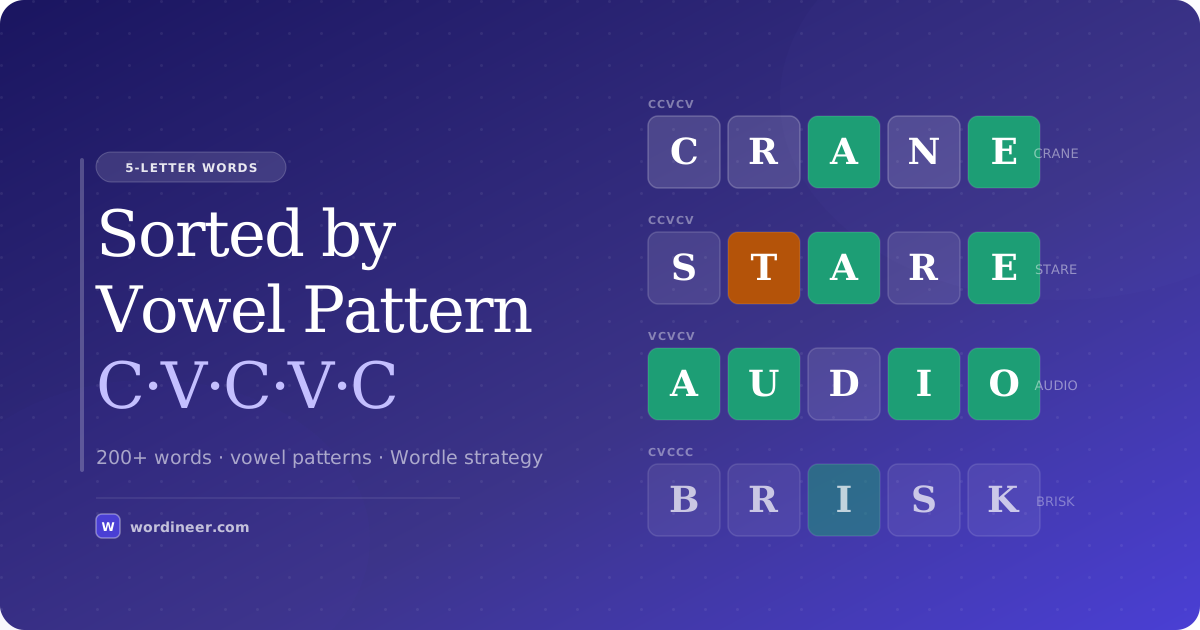
Almost two-thirds of common 5-letter words follow three vowel patterns. Here's the breakdown, plus a filterable word list.
Most Wordle strategy articles focus on letter frequency — how often does E appear, where does S show up. That's useful, but it misses something structural: the pattern of consonants and vowels in 5-letter words is heavily skewed toward a small number of templates.
In phonological notation, C stands for consonant and V stands for vowel. A word like hotel is CVCVC — consonant, vowel, consonant, vowel, consonant. Brand is CCVCC. Clean is CCVVC. If you look at a large set of common 5-letter English words, the distribution across these patterns is not even — a handful of patterns account for most of the words.
What we found: roughly 60% of common 5-letter words fall into just three patterns. The rest are distributed across six or seven others, with a long tail of rare configurations.
The concentration in CVCVC is partly a feature of how English forms common words — alternating consonants and vowels is phonologically natural and easy to pronounce. The cluster of CCVCC words reflects English's comfort with consonant clusters at both ends (brand, crisp, trust, blend).
One thing that surprised me: words with four vowels — AUDIO, QUEUE, ADIEU — are statistically rare in common 5-letter vocabulary, despite being popular first guesses in Wordle. They're memorable precisely because they're unusual.
What this means for Wordle strategy: a starting word that fits CVCVC or CCVCC will, on average, give you more information about common words than one following a rare pattern. Words like CRANE (CCVCV), SLATE (CCVCC), and ARISE (VCVCV) test high-frequency patterns. AUDIO (VVCVV), despite its vowel coverage, tests a pattern that covers a small fraction of the answer pool.
| Word | Pattern | Vowels |
|---|